






Singapore is known for its strong job market, international businesses and competitive tax system. Many people move there to work because salaries can be attractive, but understanding how much tax you need to pay is just as important when planning your income.
The good news is that Singapore uses a progressive personal income tax system for tax residents. This means you do not pay the highest tax rate on your entire salary just because your income falls into a higher tax bracket.
However, the amount you pay depends on several factors, including your annual earnings, tax residency status and eligible tax reliefs. Foreign employees may also face different rules depending on how long they stay and work in the country.
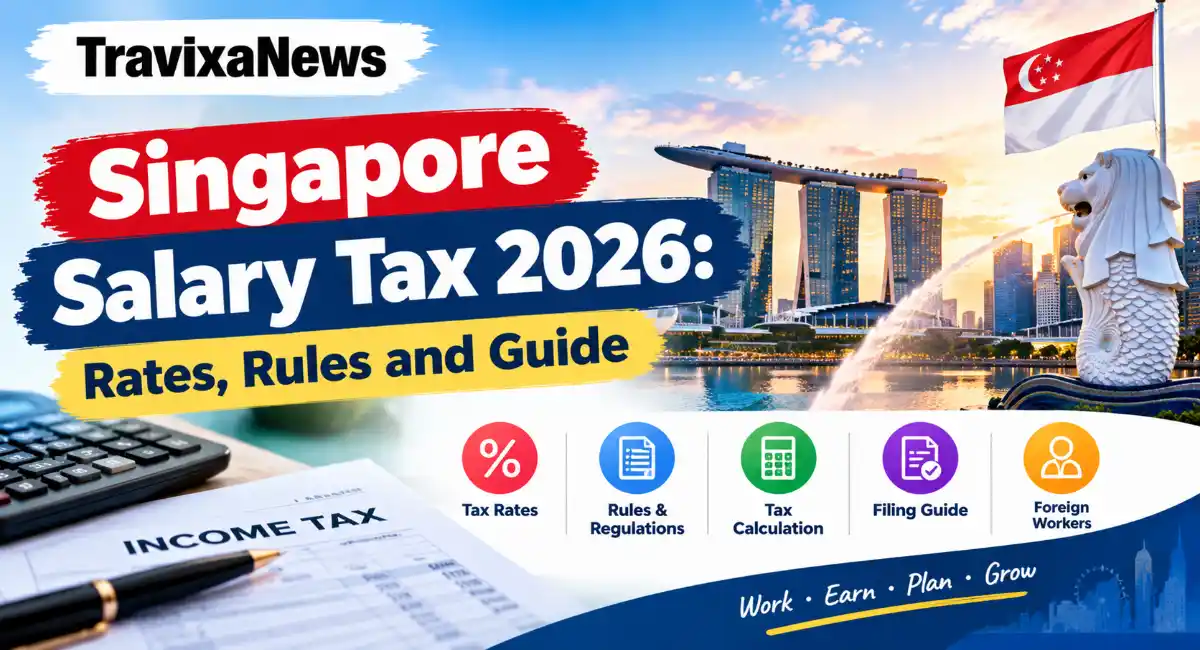
This guide explains Singapore salary tax rates, how tax is calculated, what foreigners should know and how to manage your tax filing.
What Is Salary Tax in Singapore?
Salary tax in Singapore is part of the country’s personal income tax system. Employees generally pay tax on employment income earned through work performed in Singapore, subject to the applicable tax rules and exemptions.
The Inland Revenue Authority of Singapore (IRAS) is responsible for administering individual income tax and collecting payments.
Your taxable employment income may include more than your basic monthly salary. Depending on the circumstances, it can cover:
- Basic salary and wages
- Annual bonuses and performance incentives
- Taxable allowances
- Certain benefits provided by your employer
- Director’s fees and other employment-related payments
- Other taxable employment benefits
For example, if you earn a monthly salary of S$5,000, your annual basic salary would be S$60,000 before considering bonuses, allowances or other taxable income. Your final tax calculation may therefore differ if you receive additional payments during the year.
It is also important to understand that Singapore generally assesses income tax based on the income earned in the previous calendar year. Income earned between January and December 2025 falls under Year of Assessment (YA) 2026.
You can check the details on the official IRAS individual income tax website.
Singapore Personal Income Tax Rates for 2026
Singapore has progressive tax rates for resident individuals. The rate starts at 0% on the first S$20,000 of chargeable income and gradually increases as income rises.
The following rates apply from YA 2024 onwards, including YA 2026, which covers income earned in 2025.
Tax Rates for Singapore Tax Residents
The resident income tax brackets are:
- First S$20,000: 0%
- Next S$10,000: 2%
- Next S$10,000: 3.5%
- Next S$40,000: 7%
- Next S$40,000: 11.5%
- Next S$40,000: 15%
- Next S$40,000: 18%
- Next S$40,000: 19%
- Next S$40,000: 19.5%
- Next S$40,000: 20%
- Next S$180,000: 22%
- Next S$500,000: 23%
- Income above S$1 million: 24%
These rates apply to chargeable income, not automatically to your entire gross salary. Chargeable income is calculated after allowable deductions and personal reliefs.
You can find the full rate schedule on the IRAS individual income tax rates page.
How Much Tax Do You Pay on Your Salary?
Your annual income alone does not tell the complete story. You also need to consider the progressive tax brackets and any reliefs you qualify for.
Here is a simple example to show how the system works.
Suppose you have S$60,000 in annual chargeable income and no further deductions to consider.
- The first S$20,000 is taxed at 0%, giving S$0.
- The next S$10,000 is taxed at 2%, giving S$200.
- The next S$10,000 is taxed at 3.5%, giving S$350.
- The remaining S$20,000 is taxed at 7%, giving S$1,400.
Your total income tax would be S$1,950.
This is an illustrative calculation based on S$60,000 of chargeable income. Your actual tax bill may be lower if you qualify for deductions or reliefs, or different if you have other taxable income.
This progressive system is useful because moving into a higher tax bracket does not mean that all your income is suddenly taxed at that higher rate.
Who Is Considered a Tax Resident in Singapore?
Your tax residency status is one of the most important factors when calculating Singapore salary tax.
For tax purposes, Singapore Citizens and Permanent Residents who normally live in Singapore are generally treated as tax residents, subject to the applicable rules.
Foreigners may qualify as tax residents if they meet conditions such as:
- Staying or working in Singapore for at least 183 days during the previous calendar year.
- Staying or working in Singapore continuously for three consecutive years.
- Working in Singapore over a continuous period spanning two calendar years, with a total stay of at least 183 days, subject to the relevant conditions and exceptions.
The rules can differ for company directors, public entertainers and certain other categories.
Tax residents generally pay tax at progressive rates and may claim eligible personal reliefs. If you are unsure about your status, check the official IRAS tax residency guidance.
Salary Tax Rules for Foreign Workers
Singapore attracts employees from many countries, including India, Malaysia, China and other parts of Asia. Foreign employees should not assume that their salary will be taxed in the same way as a resident’s income.
If you are a non-resident, your employment income is generally taxed at 15% or the progressive resident rates, whichever results in the higher tax amount.
For example, a foreign employee who earns S$30,000 while working in Singapore for a short period may face different tax treatment from a resident earning the same amount.
There is also a short-term employment exemption that may apply to certain non-resident employees who work in Singapore for 60 days or fewer during a calendar year. This exemption has conditions and does not apply to every category of worker or situation, including certain directors and other specified cases.
If you are moving to Singapore for a new job, it is worth checking your expected period of employment before estimating your tax bill. Your employer or a qualified tax professional can help clarify your position.
The latest rules are available in the IRAS guidance for foreign employees.
Can You Reduce Your Singapore Salary Tax?
Eligible taxpayers may be able to reduce their taxable income through personal reliefs and other permitted deductions.
However, reliefs are subject to eligibility conditions. You should not assume that every employee can claim every available benefit.
Some reliefs that may be relevant include:
Earned Income Relief: This relief is generally available to qualifying individuals with earned income. The amount depends on your age and circumstances.
CPF Relief: Eligible CPF contributions may qualify for relief under the applicable rules. The treatment depends on your employment status and contribution arrangements.
Family-related reliefs: Certain taxpayers may qualify for reliefs connected with a spouse, children, parents or caregiving responsibilities.
SRS Relief: Eligible contributions to Singapore’s Supplementary Retirement Scheme may qualify for tax relief, subject to the applicable conditions and limits.
Singapore generally imposes an overall personal income tax relief cap of S$80,000 per Year of Assessment.
Not all reliefs apply to foreigners or non-residents, and the qualifying conditions can change. Check the official IRAS tax relief guidance before claiming any deduction.
How to File Your Salary Tax Return in Singapore
Singapore’s individual income tax filing process is managed through IRAS and its myTax Portal.
For YA 2026, the filing period for income earned in 2025 ran from 1 March to 18 April 2026. The deadline has passed, so anyone who still needs to file or correct a return should check their current position with IRAS rather than relying on an old filing date.
For the applicable filing season, the general process is:
- Visit the official IRAS website.
- Open myTax Portal and sign in using the accepted digital identification method.
- Check your employment income and any pre-filled information.
- Review your eligible reliefs, deductions and other taxable income.
- Submit your return if you are required to file.
- Check your Notice of Assessment when it becomes available.
- Pay the tax by the deadline stated in your tax bill.
Some individuals qualify for the No-Filing Service. If you receive this notification, you should still review the pre-filled details and follow the instructions provided by IRAS.
Also, an employer’s submission of salary information does not automatically mean that an employee has completed every personal tax filing obligation.
What Is a Double Taxation Agreement?
A Double Taxation Agreement (DTA) is an agreement between two countries designed to address situations in which the same income could otherwise be taxed in both places.
Singapore has a network of tax treaties with other jurisdictions. These agreements can be important for employees who work across borders, overseas professionals and people who receive income from another country.
Depending on the relevant treaty and the person’s circumstances, a DTA may determine which country can tax particular income or provide relief from double taxation.
Employment income is often affected by factors such as where the work is performed, the employee’s tax residency and the duration of the assignment.
For example, an employee who lives in one country but temporarily works in Singapore may need to review the relevant treaty before deciding how their salary should be reported.
A DTA does not automatically make foreign income tax-free. The conditions of the specific agreement must be met, and supporting documents may be required.
You can review Singapore’s current treaty arrangements through the IRAS list of double taxation agreements.
Important Tax Tips for Employees in Singapore
If you are working in Singapore, a few simple habits can help you avoid unnecessary problems during tax season.
- Keep copies of your salary statements, bonus details and other employment records.
- Check your tax residency status before calculating your expected tax.
- Review your income details and reliefs instead of assuming that pre-filled information is always complete.
- Keep supporting documents for any reliefs or deductions you claim.
- If you leave Singapore or end your employment, check whether tax clearance procedures apply to your situation.
- Use official IRAS resources when checking tax rates, filing deadlines and payment instructions.
- Seek professional advice if you earn income in multiple countries or have a complicated employment arrangement.
These steps are especially helpful for foreign workers, people changing jobs and employees who receive income from overseas assignments.
Final Thoughts
Understanding Singapore salary tax can help you plan your monthly budget, compare job offers and avoid surprises when your tax bill arrives.
The main things to check are your annual income, tax residency status, applicable tax rate and any reliefs you may qualify for. Residents generally use progressive tax rates, while non-residents may be subject to different rules.
If you work in Singapore or are planning to move there for a job, use the latest information from IRAS to calculate your tax rather than relying only on general salary estimates. For complicated cases involving foreign income or double taxation, professional tax advice can also be useful.
Disclaimer: This article provides general information about Singapore salary tax and is not professional tax advice. Tax rates, reliefs, filing requirements and treaty rules may depend on your personal circumstances and the relevant Year of Assessment. Always confirm your position with IRAS or a qualified tax professional.