






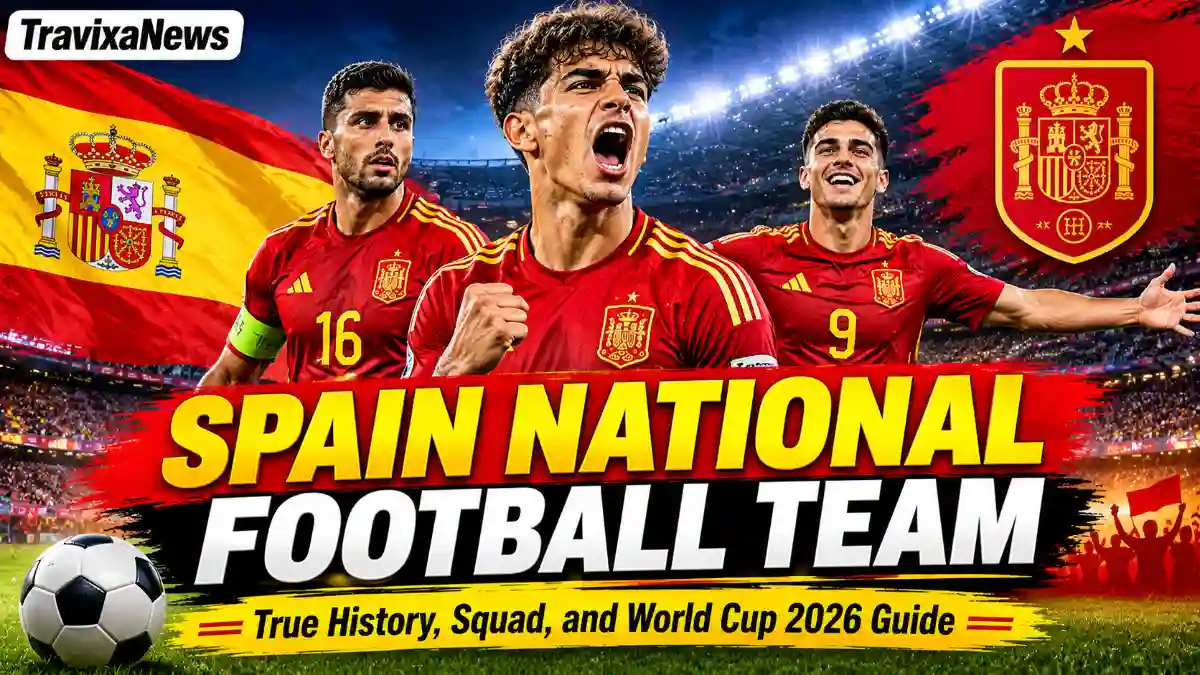
The Spain national football team is one of the most successful teams in international football. Known as La Roja, the team represents Spain in major competitions such as the FIFA World Cup, UEFA European Championship and UEFA Nations League.
Spain has produced some of the greatest footballers in history, including Andrés Iniesta, Xavi Hernández, Iker Casillas, Sergio Ramos and David Villa. In recent years, a new generation led by Lamine Yamal, Pedri, Rodri and Nico Williams has brought fresh energy to the team.
The Spanish NT became famous for its passing game and ability to control matches. Its golden period came between 2008 and 2012, when Spain won two European Championships and its first FIFA World Cup. The team returned to the top in 2024 by winning another European Championship.
Spain made history again in 2026 by winning the FIFA World Cup for the second time. The team defeated Argentina 1-0 after extra time in the final, adding another major achievement to its football history.
This guide covers the complete history of the Spain national football team, its major achievements, famous players, current squad, playing style and performance at the 2026 World Cup.
Spain National Football Team: Overview
Here are some basic details about the Spanish national football team.
| Detail | Information |
|---|---|
| Official Name | Spain National Football Team |
| Common Name | La Roja |
| Country | Spain |
| Governing Body | Royal Spanish Football Federation (RFEF) |
| Confederation | UEFA |
| Head Coach | Luis de la Fuente |
| Captain | Rodri |
| Home Colours | Red and Yellow |
| First International Match | 1920 |
| First World Cup | 1934 |
| World Cup Titles | 2 (2010, 2026) |
| European Championship Titles | 4 (1964, 2008, 2012, 2024) |
| Nations League Titles | 1 (2023) |
| Olympic Gold Medals | 2 (1992, 2024) |
Spain is a member of UEFA and competes against other European national teams in international tournaments and qualification matches.
History of the Spain National Football Team
The history of Spanish football goes back more than a century. The national team has experienced difficult periods, major disappointments and some of the greatest achievements in the sport.
1. Early Years (1920–1950)
Spain played its first official international match at the 1920 Summer Olympics in Antwerp, Belgium.
The team made a strong start by defeating Denmark 1-0. Spain eventually won the silver medal after reaching the final stages of the tournament.
This performance helped Spanish football gain recognition outside the country.
Spain made its first FIFA World Cup appearance in 1934 in Italy. The team defeated Brazil in the opening knockout round before losing to the host nation in a quarter-final replay.
The Spanish Civil War and the Second World War affected the development of football in the country. As a result, Spain missed several important international competitions during this period.
2. Spain’s First Major Trophy in 1964
Spain won its first major international trophy at the 1964 European Nations’ Cup, now known as the UEFA European Championship.
The tournament was held in Spain, and the national team had the advantage of playing in front of its home supporters.
Spain defeated Hungary in the semi-final after extra time. In the final, the team faced the Soviet Union at Santiago Bernabéu Stadium in Madrid.
Jesús María Pereda opened the scoring for Spain, while Marcelino Martínez scored the winning goal.
Spain won the final 2-1 and lifted its first European Championship trophy.
This victory was an important moment in the country’s football history.
3. Difficult Years and the 1982 World Cup
After winning the 1964 European Championship, Spain struggled to maintain the same level of success.
The team qualified for the 1982 FIFA World Cup, which was hosted in Spain. Expectations were high because the country was playing at home.
However, Spain failed to reach the later stages of the competition. The team managed only one win in the first group stage and was eliminated during the second group stage.
Despite the disappointing result, hosting the tournament helped improve football facilities and increase interest in the sport across Spain.
4. The Rise of a Strong Spanish Team (1990–2006)
The 1990s and early 2000s brought several talented players into the Spanish national team.
Players such as Raúl, Fernando Hierro, Fernando Morientes, David Albelda and Iker Casillas became important members of the squad.
Spain regularly qualified for major tournaments, but winning a major international trophy remained difficult.
At the 1994 World Cup, Spain reached the quarter-finals but lost to Italy. The team also reached the quarter-finals at EURO 1996 and the 2002 World Cup.
During this period, Spain had the talent to compete with the strongest teams, but it often failed to turn good performances into trophies.
5. Spain’s Golden Generation (2008–2012)
The period between 2008 and 2012 is widely considered the greatest era in Spanish football history.
Spain developed a team built around short passing, ball control, movement and teamwork. The style became closely associated with the term tiki-taka.
The squad featured some outstanding players, including Xavi, Andrés Iniesta, Iker Casillas, Sergio Ramos, David Villa, Fernando Torres, Carles Puyol and Sergio Busquets.
The team won three major international tournaments in a row.
UEFA EURO 2008
Spain won EURO 2008 under coach Luis Aragonés. The team defeated Germany 1-0 in the final, with Fernando Torres scoring the winning goal.
FIFA World Cup 2010
Spain won its first FIFA World Cup in South Africa in 2010.
The team lost its opening match against Switzerland but recovered and won the remaining group matches. Spain then defeated Portugal, Paraguay and Germany to reach the final.
In the final against the Netherlands, both teams failed to score during normal time. Andrés Iniesta scored in extra time to give Spain a 1-0 victory.
Iker Casillas lifted the World Cup trophy as captain, creating one of the most memorable moments in Spanish football.
UEFA EURO 2012
Spain continued its success at EURO 2012 in Poland and Ukraine.
The team defeated Italy 4-0 in the final and became the first national side to win two consecutive European Championships along with the World Cup in between.
This period established Spain as one of the greatest international football teams of all time.
6. World Cup Disappointment in 2014 and 2018
After dominating international football for several years, Spain faced a difficult period.
At the 2014 FIFA World Cup in Brazil, the defending champions were eliminated during the group stage.
Spain lost 5-1 to the Netherlands and 2-0 to Chile. Although the team defeated Australia in its final group match, it was not enough to qualify for the knockout rounds.
The 2018 World Cup in Russia was another disappointing tournament. Spain reached the Round of 16 but lost to Russia on penalties after a 1-1 draw.
These results showed that the team needed a new approach and fresh players.
7. Rebuilding the Team (2019–2022)
Spain started rebuilding under different coaching setups, with a greater focus on young talent.
Luis Enrique became head coach in 2019 and introduced a modern playing style based on possession, pressing and quick movement.
Young players such as Pedri, Gavi, Ferran Torres and Ansu Fati received opportunities in the national team.
Spain reached the semi-finals of EURO 2020, which was played in 2021 because of the pandemic. The team lost to Italy in a penalty shootout.
At the 2022 FIFA World Cup in Qatar, Spain started with an impressive 7-0 victory over Costa Rica. However, the team lost to Japan in the final group match and was eliminated by Morocco in the Round of 16.
Although the tournament ended early, it helped prepare a new generation of Spanish players for future competitions.
8. UEFA Nations League Victory in 2023
Spain won the UEFA Nations League in 2023 under new head coach Luis de la Fuente.
The team defeated Italy in the semi-final and faced Croatia in the final.
The final ended 0-0 after extra time. Spain then won the penalty shootout 5-4.
This was Spain’s first Nations League title and an important step in its return to international success.
9. Spain Wins EURO 2024
Spain enjoyed an excellent campaign at UEFA EURO 2024 in Germany.
The team won all three group-stage matches against Croatia, Italy and Albania.
Spain continued its strong performance in the knockout rounds, defeating Georgia, Germany and France before reaching the final.
In the final, Spain faced England at the Olympiastadion in Berlin.
Nico Williams opened the scoring, and Mikel Oyarzabal scored the winning goal late in the match. Spain won 2-1 and lifted its fourth European Championship trophy.
Lamine Yamal also attracted worldwide attention during the tournament. He became the youngest player to appear in a European Championship and won the Young Player of the Tournament award.
Spain’s EURO 2024 victory confirmed that the team had successfully moved into a new generation.
10. Spain Wins the 2026 FIFA World Cup
Spain entered the 2026 FIFA World Cup as one of the strongest teams in the competition after winning EURO 2024.
Under Luis de la Fuente, the team combined experienced players with young stars such as Lamine Yamal, Pedri and Nico Williams.
Spain topped Group H after drawing with Cape Verde and defeating Saudi Arabia and Uruguay.
The team then defeated Austria, Portugal, Belgium and France to reach the final.
The final took place on July 19, 2026, in New York/New Jersey. Spain faced Argentina in a closely contested match.
Ferran Torres scored the winning goal, and Spain secured a 1-0 victory after extra time.
The victory gave Spain its second men’s FIFA World Cup title, following its first triumph in 2010.
Captain Rodri led the team to the trophy and received the Golden Ball award as the tournament’s best player.
Spain also became the first country to hold the men’s and women’s FIFA World Cup titles at the same time, following the women’s team’s 2023 victory.
Spain National Football Team Squad 2026
Spain has a talented group of experienced internationals and young players. The team that won the 2026 World Cup included stars from some of Europe’s leading clubs.
Luis de la Fuente remained the head coach, while Rodri captained the side.
The following players were part of Spain’s official 2026 World Cup squad.
Goalkeepers
| Player | Position |
|---|---|
| Unai Simón | Goalkeeper |
| David Raya | Goalkeeper |
| Álex Remiro | Goalkeeper |
Defenders
| Player | Position |
|---|---|
| Dani Carvajal | Right Back |
| Marc Cucurella | Left Back |
| Aymeric Laporte | Centre Back |
| Robin Le Normand | Centre Back |
| Pau Cubarsí | Centre Back |
| Dani Vivian | Centre Back |
| Pedro Porro | Right Back |
| Alejandro Grimaldo | Left Back |
Midfielders
| Player | Position |
|---|---|
| Rodri | Defensive Midfielder |
| Pedri | Central Midfielder |
| Gavi | Central Midfielder |
| Fabián Ruiz | Central Midfielder |
| Martín Zubimendi | Defensive Midfielder |
| Mikel Merino | Central Midfielder |
| Fermín López | Attacking Midfielder |
Forwards
| Player | Position |
|---|---|
| Lamine Yamal | Right Winger |
| Nico Williams | Left Winger |
| Mikel Oyarzabal | Forward |
| Álvaro Morata | Striker |
| Ferran Torres | Forward |
| Dani Olmo | Attacking Midfielder |
| Yeremy Pino | Winger |
Note: This is a World Cup squad overview, not a guarantee of the current November 2026 selection. National team call-ups can change between international windows.
Spain National Football Team Key Players
Spain’s success has come from a mix of experienced leaders, creative midfielders and talented attackers.
Here are some of the most important players associated with the team.
1. Rodri
Rodri is one of the most important midfielders in modern football. He is known for his passing, positioning, ball control and ability to protect the defence.
He played a key role in Spain’s EURO 2024 victory and captained the national team during its 2026 World Cup triumph.
His ability to control the middle of the pitch makes him an important part of the Spanish playing style.
2. Lamine Yamal
Lamine Yamal is one of the most exciting young footballers in the world.
He became famous for his performances with Barcelona and Spain. His speed, dribbling, creativity and confidence make him dangerous in attacking positions.
Yamal played an important role in Spain’s EURO 2024 victory and continued to develop into a major player for the national team.
3. Pedri
Pedri is known for his excellent technique, vision and ability to control possession.
He can play as a central or attacking midfielder and often creates chances through quick passes and intelligent movement.
His playing style has drawn comparisons with some of Spain’s great midfielders.
4. Nico Williams
Nico Williams is a fast and direct winger who can create problems for defenders.
He is particularly dangerous when attacking from the left side. His pace, dribbling and crossing ability make him an important attacking option for Spain.
He scored the opening goal in the EURO 2024 final against England.
5. Mikel Oyarzabal
Mikel Oyarzabal is a versatile forward who can play as a striker or on the wings.
He became an important player for Spain because of his movement, finishing and ability to perform in important matches.
His winning goal in the EURO 2024 final made him a major part of Spanish football history.
6. Dani Olmo
Dani Olmo is an attacking midfielder who can also play on either wing.
He is known for his close control, passing and ability to find space between opposition defenders.
His performances at EURO 2024 helped Spain create chances and maintain pressure on opponents.
Spain National Football Team Famous Players of All Time
Spain has produced many world-class footballers throughout its history.
Some of the most famous names include:
| Player | Position | Known For |
|---|---|---|
| Iker Casillas | Goalkeeper | 2010 World Cup captain |
| Xavi Hernández | Midfielder | Passing and midfield control |
| Andrés Iniesta | Midfielder | 2010 World Cup final goal |
| Sergio Ramos | Defender | Leadership and defensive ability |
| Carles Puyol | Defender | Strong defending and captaincy |
| David Villa | Forward | Spain’s leading World Cup scorer |
| Fernando Torres | Forward | EURO 2008 winning goal |
| Raúl | Forward | One of Spain’s historic goal scorers |
| Sergio Busquets | Midfielder | Defensive midfield and ball control |
| Cesc Fàbregas | Midfielder | Creativity and passing |
These players helped Spain become one of the most respected teams in international football.
Spain National Football Team Major Achievements
Spain has won several major international tournaments across different generations.
Here is a look at the team’s most important achievements.
| Competition | Titles | Winning Years |
|---|---|---|
| FIFA World Cup | 2 | 2010, 2026 |
| UEFA European Championship | 4 | 1964, 2008, 2012, 2024 |
| UEFA Nations League | 1 | 2023 |
| Olympic Gold Medal | 2 | 1992, 2024 |
Spain’s four European Championship titles make it the most successful men’s team in the history of the competition.
The 2026 World Cup victory also strengthened its position among the greatest national teams in football.
Spain National Football Team World Cup History
Spain first appeared at the FIFA World Cup in 1934. Since then, the team has taken part in many editions of the tournament.
Its biggest achievements came in 2010 and 2026, when Spain lifted the trophy.
Here is a quick look at some important World Cup performances.
| Year | Host Country | Spain’s Result |
|---|---|---|
| 1934 | Italy | Quarter-finals |
| 1950 | Brazil | Fourth Place |
| 1982 | Spain | Second Group Stage |
| 1986 | Mexico | Quarter-finals |
| 1994 | USA | Quarter-finals |
| 2002 | South Korea/Japan | Quarter-finals |
| 2006 | Germany | Round of 16 |
| 2010 | South Africa | Champions |
| 2014 | Brazil | Group Stage |
| 2018 | Russia | Round of 16 |
| 2022 | Qatar | Round of 16 |
| 2026 | Canada, Mexico and USA | Champions |
The 2010 victory was Spain’s first World Cup title. Its 2026 triumph gave the country a second star on the national team’s badge.
Spain’s Road to the 2026 World Cup Final
Spain had an impressive campaign at the 2026 FIFA World Cup.
The team won its group and then defeated several strong opponents in the knockout rounds.
Group Stage
| Match | Result |
|---|---|
| Spain vs Cape Verde | 0-0 |
| Spain vs Saudi Arabia | 4-0 |
| Uruguay vs Spain | 0-1 |
Spain finished at the top of Group H.
Knockout Stage
| Round | Opponent | Result |
|---|---|---|
| Round of 32 | Austria | Spain won 3-0 |
| Round of 16 | Portugal | Spain won 1-0 |
| Quarter-final | Belgium | Spain won 2-1 |
| Semi-final | France | Spain won 2-0 |
| Final | Argentina | Spain won 1-0 after extra time |
Spain scored important goals throughout the knockout rounds and showed strong defensive discipline.
The final against Argentina was the biggest test. Spain remained organised and eventually secured the winning goal in extra time.
Spain National Football Team Coach
Luis de la Fuente is the head coach of the Spanish national football team.
He took charge in December 2022 after Luis Enrique left the position following the World Cup in Qatar.
Before becoming the senior team manager, de la Fuente worked with Spain’s youth teams. He coached the Under-19 and Under-21 sides and helped develop several players who later became part of the senior squad.
His biggest achievements with the senior team include:
- Winning the UEFA Nations League in 2023.
- Winning UEFA EURO 2024.
- Winning the FIFA World Cup in 2026.
His coaching style combines possession-based football with faster attacks and strong defensive organisation.
Spain National Football Team Playing Style
Spain is famous for its possession-based football.
During the golden generation, the team became closely linked with tiki-taka. This style focuses on short passes, movement, patience and keeping control of the ball.
However, modern Spain is not limited to slow passing.
Under Luis de la Fuente, the team also uses direct attacks, quick transitions and wide players who can take on defenders.
Players such as Lamine Yamal and Nico Williams bring speed and creativity, while Rodri and Pedri help control the midfield.
This combination allows Spain to adjust its approach depending on the opponent.
Spain National Football Team Ranking and Current Form
Spain entered the final part of 2026 as one of the strongest teams in international football.
The country won the FIFA World Cup in July and continued its strong performances in the 2026–27 UEFA Nations League.
In September and October, Spain defeated England, Croatia and Czechia in its first four group matches.
The team then beat Czechia 2-0 on November 12 but lost 3-2 to England on November 15.
Despite the final defeat, Spain had already secured qualification for the Nations League quarter-finals.
According to the Spanish Football Federation’s November 2026 information, Spain was also ranked number one in the FIFA men’s world ranking.
Its recent results show that the team remains competitive after its World Cup triumph.
Why the Spain National Football Team Is So Successful
Spain’s success is the result of several factors.
Strong youth development: Spanish clubs and football academies focus on technical skills, passing and game awareness from an early age.
Quality midfielders: Spain has produced many outstanding midfielders, including Xavi, Iniesta, Busquets, Pedri and Rodri.
Teamwork: The national team relies on movement, passing and coordinated defending rather than depending on one player.
Experienced coaching: Coaches such as Luis Aragonés, Vicente del Bosque and Luis de la Fuente have helped shape successful Spanish teams.
New generation of talent: Young players such as Lamine Yamal, Pedri and Nico Williams have helped Spain maintain a strong team for the future.
These factors have played an important role in Spain’s achievements across different generations.
Conclusion
The Spain national football team has built an impressive history through hard work, talented players and a clear football identity.
From its first international appearance in 1920 to its major trophies in 1964, 2008, 2010, 2012, 2023 and 2024, Spain has enjoyed several memorable moments.
The golden generation of Xavi, Iniesta and Casillas changed the country’s football history, while the new generation led by Rodri, Lamine Yamal, Pedri and Nico Williams has taken the team to another level.
Winning the 2026 FIFA World Cup was another major achievement. It gave Spain its second World Cup title and confirmed its place among the most successful national teams in the sport.
With a strong youth system, talented players and an experienced coach, La Roja remains one of the most exciting teams to follow in international football.
Frequently Asked Questions (FAQs)
1. What is the Spain national football team also called?
The Spain national football team is commonly known as La Roja, which means “The Red One” in Spanish. The nickname comes from the team’s traditional red home jersey.
2. How many FIFA World Cups has Spain won?
Spain has won two men’s FIFA World Cup titles. The team won its first trophy in 2010 in South Africa and its second in 2026 after defeating Argentina 1-0 in the final.
3. Who is the current coach of the Spanish NT?
Luis de la Fuente is the head coach of the Spain national football team. He took charge in December 2022 and led Spain to the UEFA Nations League, EURO 2024 and FIFA World Cup 2026 titles.
4. Who is the captain of Spain’s national football team?
Rodri is the captain of Spain. The midfielder led the national team during its successful 2026 World Cup campaign.
5. Who are the most famous players in Spain’s national football team?
Some of Spain’s most famous players include Andrés Iniesta, Xavi Hernández, Iker Casillas, Sergio Ramos, David Villa, Rodri, Pedri, Lamine Yamal and Nico Williams.