
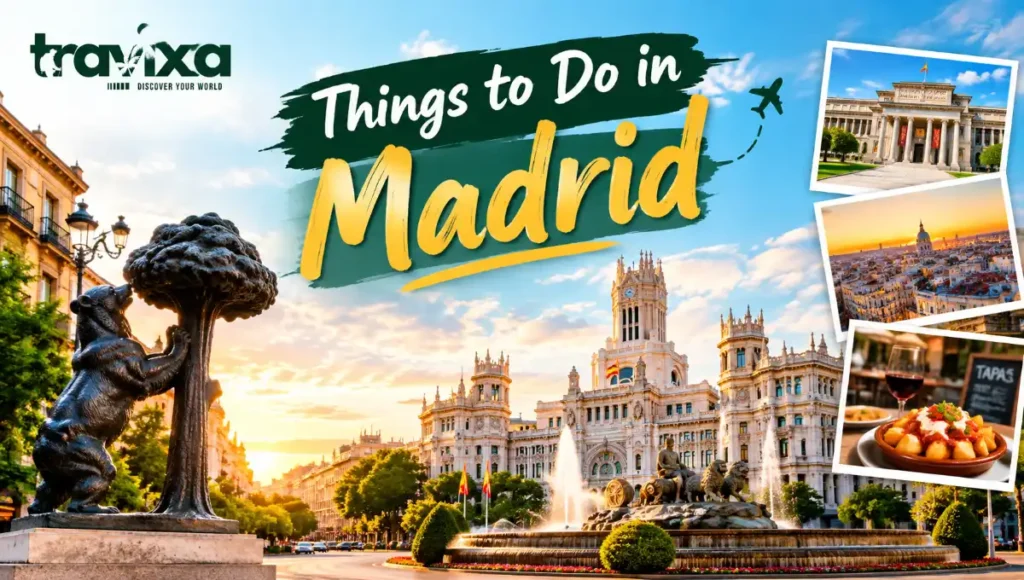

Things to Do in Madrid: Madrid is the kind of city that gives you something different every few hours. In the morning, you can walk through a grand royal palace or spend time looking at famous paintings. By afternoon, you can relax in a huge green park, stop for tapas, and explore streets filled with old buildings and small cafés. Once the sun goes down, Madrid becomes even more lively, with busy plazas, restaurants, bars, and late-night activity.
Spain’s capital is also a city where history and modern life sit very close together. The old streets around Plaza Mayor and La Latina tell a very different story from the creative cafés and international restaurants of Malasaña. This mix is one of the reasons Madrid is such an interesting place to explore.
If you are visiting Madrid for the first time, there is a lot to fit into your trip. This guide covers the main attractions as well as food, neighborhoods, parks, museums, football, and a few easy day-trip ideas.
1. Visit the Prado Museum
The Museo del Prado is one of Madrid’s most important attractions and a major stop for anyone interested in European art.
The museum is especially important for understanding Spanish painting. Its collection includes famous works by artists such as Francisco Goya, Diego Velázquez, and El Greco, along with paintings from other European traditions.
You do not need to spend an entire day trying to see every room. The Prado is large, so it is better to choose a few sections or artists that interest you and explore them properly.
Some visitors also prefer joining a guided tour because the history behind many of the paintings makes the collection easier to understand.
If you plan to visit during a busy travel period, check ticket availability ahead of time. The museum can become crowded, particularly during popular travel months.
2. Take a Walking Tour of Madrid
One of the easiest ways to understand Madrid is to explore it on foot.
A walking tour can take you through some of the city’s oldest streets while explaining how Madrid developed from a relatively small settlement into the capital of Spain. You can learn about the city’s royal history, old neighborhoods, important squares, and changing architecture.
It is also a useful way to get your bearings at the beginning of a trip. After a walking tour, places such as Plaza Mayor, Puerta del Sol, the Royal Palace, and La Latina make much more sense when you explore them on your own.
If you do not want a formal tour, you can also create your own walking route through the historic center.
Read More Also – Things to Do in Vancouver: A Complete Guide for First-Time Visitors
3. Explore the Reina Sofía Museum
For modern and contemporary art, head to the Museo Nacional Centro de Arte Reina Sofía.
The museum is particularly famous for Picasso’s Guernica, one of the most recognizable works of 20th-century Spanish art. You will also find works connected with artists such as Salvador Dalí and Joan Miró.
The Reina Sofía is very different from the Prado. Instead of focusing mainly on older European paintings, it takes you into Spain’s more modern artistic history.
If modern art is not normally your thing, consider joining a guided visit. Having someone explain the background of major works can make the experience much easier to appreciate.
4. Discover Spain’s Past at the National Archaeological Museum
Madrid has plenty to offer beyond its famous art museums.
The National Archaeological Museum is a good choice if you want to understand the much older history of Spain. Its collection covers different civilizations and periods that influenced the Iberian Peninsula.
You can find objects connected with prehistoric communities, ancient Iberian cultures, Romans, Visigoths, and later periods.
The museum helps explain why Spanish culture is so diverse. Spain’s history was shaped by many different peoples and civilizations, and you can see traces of those influences in its architecture, language, art, and traditions.
5. Go on a Tapas Crawl
Food is one of the best ways to experience Madrid.
Rather than sitting down for one large meal, consider visiting several tapas bars and ordering a few small dishes at each stop. This lets you try different foods while moving through the historic center.
Around areas such as Plaza Mayor and La Latina, you will find plenty of traditional bars and restaurants.
Some foods worth looking for include:
- Patatas bravas
- Croquetas
- Jamón
- Spanish omelette
- Fried calamari
- Gildas
- Local cheeses
- Churros with chocolate
Madrid also has its own food traditions, so do not assume every famous Spanish dish is necessarily a local Madrid specialty.
One particularly famous local snack is the bocadillo de calamares, a fried calamari sandwich. It may sound unusual for a city far from the coast, but it has become closely associated with Madrid’s food culture.
6. Try Churros con Chocolate
You cannot talk about things to do in Madrid without mentioning churros.
Madrid-style churros are usually long and thin, with a crisp outside and soft interior. They are commonly served with a cup of thick hot chocolate for dipping.
Churros are especially popular in the morning or later in the evening, and visiting a traditional churrería can be a fun part of your Madrid food experience.
One of the city’s best-known names is Chocolatería San Ginés, which has been serving churros and chocolate for more than a century.
You will also find plenty of other churrerías around the central neighborhoods, so you do not necessarily need to visit the most famous one.
7. Spend Time in El Retiro Park
Madrid can feel busy, especially around the historic center. El Retiro Park gives you a chance to slow down.
The park, officially known as Parque del Buen Retiro, is one of the city’s most famous green spaces. It was once connected with the Spanish royal family and later became a public park.
There is plenty to see while walking around the grounds.
The Crystal Palace, or Palacio de Cristal, is one of the most recognizable structures in the park. The large glass-and-metal building creates a beautiful setting and is one of the most photographed places in El Retiro.
You can also visit the large lake, walk through the gardens, and see the monument dedicated to King Alfonso XII.
El Retiro is particularly enjoyable when you want a break from museums and busy streets.
8. Visit the Royal Palace of Madrid
The Royal Palace is one of Madrid’s most impressive landmarks.
The palace stands on a site that has been associated with Madrid’s early history and earlier fortifications. The present building dates largely from the 18th century and reflects the influence of the Bourbon dynasty.
Today, parts of the palace are open to visitors. Inside, you can see grand rooms, royal apartments, ceremonial spaces, and historic decorations.
Even if you do not go inside, the area around the palace is worth exploring. The Sabatini Gardens behind the palace provide a quieter setting and offer attractive views of the building.
Because the Royal Palace is one of Madrid’s major attractions, booking tickets ahead of time can save you from long queues.
9. See Almudena Cathedral
Right beside the Royal Palace is the Catedral de la Almudena.
Unlike many famous European cathedrals, Almudena Cathedral is relatively young. Construction took many decades, and the cathedral was finally consecrated in 1993.
Its interior is especially interesting because of the colorful stained-glass windows and modern decorative details.
The cathedral’s location also makes it easy to combine with a visit to the Royal Palace. You can explore both attractions in the same part of the city without spending much time traveling between them.
Read More Also – Things to See in Amsterdam: A Complete Guide for First-Time Visitors
10. Explore La Latina
La Latina is one of the best neighborhoods to explore if you want a taste of traditional Madrid.
The area is known for its narrow streets, old buildings, tapas bars, terraces, and lively atmosphere.
One of the main streets to know is Calle Cava Baja, where you can find numerous places to eat and drink.
La Latina is also home to El Rastro, Madrid’s famous open-air market. It takes place on Sundays and public holidays and attracts both locals and visitors.
The neighborhood is a good place to visit during the day and return to in the evening for tapas or drinks.
11. Wander Around Malasaña
For a completely different atmosphere, head north toward Malasaña.
Malasaña mixes older Madrid architecture with independent cafés, restaurants, bars, shops, and a younger nightlife scene.
It is a particularly interesting neighborhood for food lovers because the restaurant scene goes well beyond traditional Spanish dishes. You can find international food, specialty coffee, bakeries, cocktails, and plenty of casual places to sit outside.
The neighborhood is also a good place to simply walk without following a strict sightseeing route.
Stop at a plaza, find a terrace, order a drink, and watch the city go by.
12. Enjoy Madrid’s Café and Coffee Culture
Madrid has a long café tradition, but the city also has a growing specialty coffee scene.
If you enjoy good coffee, neighborhoods such as Malasaña are worth exploring. You will find independent cafés serving different beans, brewing styles, pastries, and light meals.
This is a nice activity for a slower morning, especially if you have already spent several days visiting museums and major attractions.
Rather than rushing from one landmark to another, take an hour to sit down, have coffee, and experience Madrid’s everyday rhythm.
13. Experience Madrid After Dark
Madrid is famous for its nightlife, and the city does not become quiet when the sun goes down.
Many locals eat dinner later than visitors from countries where evening meals start early. Streets and plazas can become much busier later in the evening.
Malasaña, Chueca, La Latina, and other central neighborhoods are popular places for evening drinks and socializing.
You do not have to visit a nightclub to enjoy Madrid at night. A simple evening of tapas, a drink on a terrace, and a walk through the illuminated streets can be enough.
14. Watch a Football Match
Football is deeply connected with Spanish culture, and Madrid has two internationally famous clubs: Real Madrid and Atlético de Madrid.
If a match takes place during your visit, attending one can be a memorable experience even if you are not a serious football fan.
The atmosphere inside a Spanish football stadium can be very different from simply watching a game on television. Supporters sing, chant, celebrate, and react to every important moment.
If there is no suitable match during your trip, stadium tours can provide another way to experience Madrid’s football culture.
Always check the club’s official ticketing information before buying tickets and be cautious with unofficial ticket sellers.
15. Take a Day Trip to Toledo
Madrid is also an excellent base for exploring central Spain.
One of the most popular day trips is Toledo, a historic city located outside Madrid. It once played a much more important political and cultural role in Spain before Madrid became the country’s capital.
Toledo is known for its medieval streets, historic buildings, churches, and the influence of Christian, Jewish, and Muslim cultures.
The city sits above the Tagus River and has a very different atmosphere from modern Madrid.
If you have an extra day, Toledo can add an entirely different side of Spanish history to your trip.
16. Explore Madrid’s Historic Center
Do not spend your entire Madrid trip moving from one attraction to another.
Some of the best parts of the city can be found simply by walking through the historic center.
Start around Puerta del Sol, continue toward Plaza Mayor, and then wander through the surrounding streets. You will find old cafés, small shops, restaurants, churches, historic buildings, and busy pedestrian areas.
From there, you can continue toward the Royal Palace, Almudena Cathedral, La Latina, or other nearby neighborhoods.
This part of Madrid is especially enjoyable when you leave some time in your itinerary without a fixed plan.
17. Visit Plaza Mayor
Plaza Mayor is one of Madrid’s most recognizable squares.
The large rectangular plaza is surrounded by historic buildings with balconies and arcades. Over the centuries, it has served different purposes, including markets, public celebrations, and other major events.
Today, it is one of the busiest meeting points in central Madrid.
It is worth seeing during the day, but also consider returning after sunset when the surrounding buildings and streets take on a different atmosphere.
Because the square is highly visited, restaurants immediately around it can be more tourist-oriented. Walking a few streets away can give you more choices.
18. Explore Madrid Through Its Neighborhoods
One of the easiest mistakes first-time visitors make is staying only around the biggest attractions.
Madrid becomes more interesting when you explore different neighborhoods.
La Latina is a good choice for traditional tapas and older streets.
Malasaña is known for independent cafés, international food, bars, and nightlife.
Chueca is another lively central area with restaurants, bars, shops, and a strong nightlife scene.
Barrio de las Letras is worth exploring for its literary history, attractive streets, restaurants, and traditional atmosphere.
You do not need to visit every neighborhood. Choose two or three and give yourself enough time to actually experience them.
Read More Also – Things to Do in London for First Timers
19. Take Your Time With Madrid’s Food Culture
Madrid is not just about famous attractions. Food can easily become one of the highlights of your trip.
Try eating at different times of day and explore different types of places. A traditional taberna, a modern restaurant, a neighborhood bakery, and a tapas bar can all give you different impressions of the city.
Remember that Spanish meal times may feel later than what you are used to. Lunch is often taken in the afternoon, while dinner can start much later in the evening.
Instead of trying to follow your normal schedule, adjust to the local rhythm when possible.
How Many Days Do You Need in Madrid?
For a first visit, 3 days in Madrid gives you enough time to see many of the major attractions without making every day exhausting.
With three days, you could spend one day exploring the historic center and Royal Palace, another around the Prado and El Retiro, and another exploring neighborhoods such as La Latina and Malasaña.
If you have four or five days, you can slow the pace down and add a day trip to Toledo.
The ideal length depends on how much time you want to spend in museums, neighborhoods, restaurants, and nearby cities.
Best Time to Visit Madrid
Madrid can be visited throughout the year, but spring and autumn are particularly comfortable for walking and sightseeing.
Summer can be very hot, especially in July and August. If you visit during the hottest part of the year, plan outdoor activities for the morning or evening and take breaks during the hottest hours.
Winter is generally quieter than the main tourist season and can be a good option if you prefer fewer crowds and cooler weather.
No matter when you visit, bring comfortable shoes. Madrid is a city that rewards walking.
Getting Around Madrid
Madrid has an extensive public transport system, including the Metro, buses, and commuter trains.
The central areas are also very walkable, and many major attractions are close enough to combine in a single day.
For longer journeys, the Metro is usually one of the easiest options. You can also use taxis and ride-hailing services when needed.
A good strategy is to group attractions by neighborhood instead of crossing the entire city several times in one day.
Final Thoughts on Things to Do in Madrid
Madrid is much more than a collection of famous landmarks.
Yes, you should see the Prado, Royal Palace, Plaza Mayor, El Retiro, and Almudena Cathedral. But leave some room for the experiences that happen between those places.
Sit at a terrace in Malasaña. Walk through La Latina. Try a few tapas. Have churros with hot chocolate. Spend an afternoon in a park. Visit a local market. Watch football if the schedule works. And if you have extra time, take the train to Toledo.
The best way to experience Madrid is to combine its history and major attractions with its everyday side. That balance is what makes the Spanish capital such an enjoyable city for a first visit.
Frequently Asked Questions
Q1. What is Madrid best known for?
Madrid is known for its art museums, royal history, grand architecture, food culture, nightlife, football clubs, and lively neighborhoods.
Q2. How many days are enough for Madrid?
Three days is a good starting point for a first visit. Four or five days gives you more time to explore neighborhoods and add a day trip.
Q3. What are the best things to do in Madrid for first-time visitors?
Some of the main experiences include visiting the Prado Museum, exploring the Royal Palace, walking around Plaza Mayor, relaxing in El Retiro, trying tapas, visiting La Latina and Malasaña, and seeing Almudena Cathedral.
Q4. Is Madrid a walkable city?
Yes. Many attractions in central Madrid are close together, making walking a convenient way to explore. The Metro is useful for longer journeys.
Q5. What food should you try in Madrid?
Try traditional tapas, patatas bravas, croquetas, jamón, bocadillo de calamares, churros con chocolate, and other local dishes.