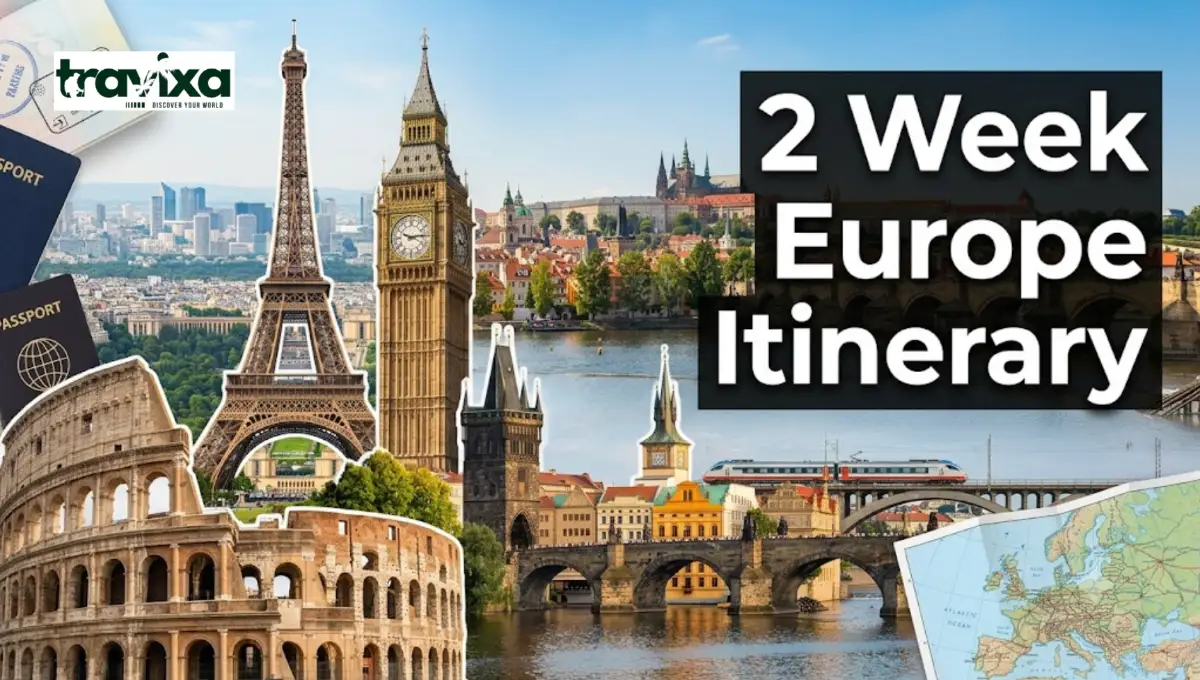







Planning a trip to Europe for the first time can feel exciting, but it can also become confusing very quickly. Europe has so many countries, cities, historic places, beaches, museums, and beautiful towns that choosing where to go in just two weeks is not easy.
A good 2 week Europe itinerary should give you enough time to enjoy a few important destinations without spending most of the trip sitting on trains, buses, or at airports.
For a first trip, it is better to visit a small number of cities and enjoy them properly rather than trying to see everything. This guide covers a practical 14-day Europe route, transport options, budgeting, the best time to visit, packing tips, and a few alternative itineraries.
How to Plan a 2 Week Europe Trip
Two weeks is enough time to experience several parts of Europe, but it is not enough to explore the whole continent.
Before booking anything, decide what kind of trip you want. Do you want famous cities, historic sites, food, museums, nightlife, nature, or a mixture of everything?
For first-time visitors, a route through major European cities can be a simple starting point. Cities such as London, Paris, Berlin, Prague, Budapest, and Rome offer very different experiences and are well known among international travelers.
Try to keep your route logical. Moving back and forth between countries wastes time and can make the trip tiring.
How Many Countries Can You Visit in 2 Weeks?
There is no fixed number of countries you should visit.
You could visit three or four countries and spend more time in each place, or visit five or six countries with shorter stays.
For a first trip, around four to six major destinations can work if the transport connections are convenient. However, remember that changing cities also takes time for packing, checking out, traveling, and checking into your next hotel.
A two-week trip does not mean you have 14 full sightseeing days.
Read More Also – Europe Trip Cost: Complete Budget Guide for Europe Travel From India
Best Time for a 2 Week Europe Itinerary
Europe can be visited throughout the year, but different seasons offer very different experiences.
Spring
March to May is a good period for city sightseeing. The weather starts getting warmer, parks become greener, and the summer crowds are generally smaller.
April and May can be particularly comfortable for walking around European cities.
Summer
June to August is the busiest travel period in many parts of Europe.
The days are long and the weather is good for outdoor activities, but popular cities can become crowded. Hotels and flights can also cost more during peak periods.
Northern European destinations can be especially pleasant during summer.
Autumn
September and October can be a comfortable time for a Europe trip. The weather is often suitable for sightseeing, while some summer crowds start to disappear.
Southern European destinations can still feel warm during early autumn.
Winter
November to February is generally quieter in many European cities, although Christmas markets and winter events can make December particularly busy.
Winter is also a good time for travelers interested in museums, historic attractions, Christmas markets, and lower-season city travel.
How to Travel Around Europe
Transport is one of the most important parts of planning a 2 week Europe itinerary.
You can travel by train, plane, bus, or rental car. The right choice depends on your route.
Traveling by Train
Trains are one of the most useful ways to move between many European cities.
They are especially convenient when destinations are relatively close to each other. You can often arrive in the city center instead of traveling from an airport outside the city.
Train travel can also be more comfortable than flying for shorter journeys.
However, check the actual journey time and ticket price before booking. A train is not automatically the cheapest option.
Traveling by Plane
Flying can make sense when two destinations are far apart.
For example, if your itinerary moves from Central Europe to Italy, a short flight may save several hours compared with a long overland journey.
Remember to include airport transfers, security checks, and waiting time when comparing flights with trains.
Traveling by Bus
Buses can be useful for travelers on a tighter budget.
Many European cities have long-distance bus connections. The main disadvantage is that journeys can take longer than trains or flights.
Renting a Car
A rental car is useful when your trip focuses on small towns, countryside, mountains, or areas with limited public transportation.
For major cities such as London, Paris, Rome, and Berlin, a car is usually less convenient because of traffic, parking, and city driving.
For a city-focused itinerary, trains and public transport are often simpler.
Read More Also – 10 Day Europe Itinerary: Simple Travel Plan for First Time Visitors
Europe Travel Budget for 2 Weeks
Your total budget depends heavily on your destination and travel style.
Western European capitals such as London and Paris can be expensive, while some Central European destinations may offer more affordable accommodation and food.
For a comfortable trip, consider these major expenses:
- Flights to and from Europe
- Hotels or hostels
- Intercity transportation
- Local public transport
- Food and drinks
- Attraction tickets
- Travel insurance
- SIM or eSIM
- Shopping and other personal expenses
Instead of using one fixed budget for every European country, check hotel and transport prices for your exact route before booking.
Booking accommodation and major transportation early can also help you understand the real cost of your trip.
Internet and Connectivity in Europe
Having internet access makes traveling between countries much easier.
You can use your phone for maps, train schedules, hotel information, translation, tickets, and restaurant searches.
An eSIM can be useful if your phone supports it. A regional European plan can save you from buying a separate SIM card every time you cross a border.
Before leaving home, check whether your phone is unlocked and whether your current mobile plan already includes European roaming.
Travel Insurance for Europe
Travel insurance is worth considering for a multi-country trip.
A policy can provide protection for certain medical emergencies, trip problems, lost luggage, and other covered situations depending on the plan.
Read the policy carefully before buying it. Check what countries are included, what medical expenses are covered, and whether there are exclusions or limits.
Important Tips Before Your Europe Trip
A little preparation can make a big difference during a two-week trip.
Book Popular Attractions Early
Some famous museums and attractions have timed entry or limited daily availability.
If there is a particular attraction you really want to visit, check its official booking system before your trip.
Do Not Change Hotels Every Night
Moving constantly can make a trip exhausting.
Whenever possible, stay at least two nights in a city. This gives you time to explore without spending every morning packing your bags.
Stay Near Public Transport
You do not always need to stay directly beside the main tourist attractions.
A hotel close to a metro, train, or tram station can make getting around much easier.
Keep Some Flexibility
Do not fill every hour of your itinerary.
Flights can be delayed, trains can run late, weather can change, and you may discover a place where you want to spend more time.
Leaving some free time can make your trip more enjoyable.
Check Entry Requirements
Visa and entry rules depend on your nationality, destination, and travel date.
Always check the latest requirements through official government or embassy sources before your trip.
The Main 2 Week Europe Itinerary
Here is a practical route for first-time visitors:
| Day | Destination | Country |
|---|---|---|
| Day 1–2 | London | United Kingdom |
| Day 3–4 | Paris | France |
| Day 5–7 | Berlin | Germany |
| Day 8–9 | Prague | Czech Republic |
| Day 10–11 | Budapest | Hungary |
| Day 12–14 | Rome | Italy |
This route gives you a mixture of famous landmarks, history, architecture, food, culture, and different European city experiences.
Days 1–2: London
Start your European trip in London.
London is a huge city, so two days will not be enough to see everything. However, you can still visit several famous places and get a good introduction to the city.
Depending on your interests, you can visit places such as:
- Tower Bridge
- Buckingham Palace
- Westminster Abbey
- Big Ben and the Houses of Parliament
- The British Museum
- St Paul’s Cathedral
- The London Eye
- Trafalgar Square
Use the Underground and other public transport to save time.
Since London can be expensive, compare accommodation prices carefully. Staying slightly outside the busiest central areas can sometimes give you better value while keeping you close to public transport.
Days 3–4: Paris
Take the train or another suitable connection from London to Paris.
Paris is one of the most visited cities in Europe and has plenty to see in a short amount of time.
For a first visit, you may want to see:
- Eiffel Tower
- Louvre Museum
- Notre-Dame area
- Arc de Triomphe
- Champs-Élysées
- Montmartre
- Seine River
Do not try to visit every museum and attraction in two days.
Choose a few places that interest you most and leave time to walk around different neighborhoods. Paris is also a city where simply sitting at a café or walking along the Seine can become part of the experience.
Days 5–7: Berlin
After Paris, continue toward Berlin.
Three days give you more time to explore the city and understand its history and modern culture.
Some places to consider include:
- Brandenburg Gate
- Reichstag Building
- Berlin Wall Memorial
- East Side Gallery
- Museum Island
- Berlin Cathedral
- Checkpoint Charlie
- Memorial to the Murdered Jews of Europe
Berlin is quite different from Paris and London. Its history, architecture, art, food, and neighborhoods give the city its own character.
Use public transport to move between different parts of the city.
Days 8–9: Prague
Next, travel to Prague.
Prague is known for its historic center, old buildings, bridges, and attractive streets.
During two days, you can explore:
- Prague Castle
- Charles Bridge
- Old Town Square
- Astronomical Clock
- St. Vitus Cathedral
- Wenceslas Square
- Vltava riverfront
The historic center is enjoyable to explore on foot, but comfortable shoes are important because you will likely spend a lot of time walking.
Try to start early at the busiest attractions if you want a quieter experience.
Read More Also – Europe Itinerary: Best 2 Week Travel Plan for First Time Visitors
Days 10–11: Budapest
Continue to Budapest for the next part of your trip.
Budapest sits along the Danube River and combines historic architecture with a lively modern atmosphere.
Popular places to see include:
- Hungarian Parliament Building
- Buda Castle
- Fisherman’s Bastion
- Chain Bridge
- St. Stephen’s Basilica
- Great Market Hall
- Széchenyi Thermal Bath
A walk along the Danube is one of the easiest ways to see some of the city’s major sights.
You can also consider an evening river cruise if it fits your budget and schedule.
Days 12–14: Rome
Finish your 2 week Europe itinerary in Rome.
Depending on your route and available flights, flying from Budapest to Rome may be more practical than traveling overland.
Rome has an enormous amount of history packed into one city.
Important places to consider include:
- Colosseum
- Roman Forum
- Trevi Fountain
- Pantheon
- Spanish Steps
- Piazza Navona
- Vatican City
- St. Peter’s Basilica
Three days will give you a reasonable introduction, but Rome deserves much more time if you have it.
Avoid planning too many attractions for one day. Walking through Rome’s streets, stopping for food, and exploring smaller areas can be just as enjoyable as visiting famous landmarks.
Alternative 2 Week Europe Itineraries
The main route above is not the only way to spend two weeks in Europe.
Your itinerary can change completely depending on your interests.
Classic Western Europe Route
If you want a more traditional first European trip, consider:
- Days 1–3: Paris
- Days 4–5: Amsterdam
- Days 6–8: Berlin
- Days 9–10: Prague
- Days 11–12: Vienna
- Days 13–14: Rome
This route covers several famous European cities but requires careful planning between destinations.
Central Europe Route
If you prefer shorter distances between destinations, a Central European route can work well:
- Days 1–3: Prague
- Days 4–6: Vienna
- Days 7–9: Budapest
- Days 10–12: Krakow
- Days 13–14: Bratislava
This option focuses more on Central European architecture, history, food, and city life.
Southern Europe Route
For warmer weather, Mediterranean food, and historic cities, consider:
- Days 1–3: Barcelona
- Days 4–6: Rome
- Days 7–9: Florence
- Days 10–12: Venice
- Days 13–14: Athens
This route works particularly well for travelers interested in ancient history, architecture, food, and coastal European culture.
2 Week Europe Itinerary by Train
Europe is also excellent for a train-based trip.
One possible route is:
- Days 1–2: Paris
- Days 3–4: Amsterdam
- Days 5–7: Berlin
- Days 8–9: Prague
- Days 10–11: Vienna
- Days 12–14: Budapest
Before buying a rail pass, compare the pass price with individual train tickets. Advance tickets can sometimes be cheaper, while a rail pass may offer more flexibility depending on your plans.
How to Make Your 2 Week Europe Trip Easier
The biggest mistake first-time visitors make is trying to fit too much into one trip.
Europe will still be there on your next visit.
Instead of adding another five cities, spend extra time exploring the places already on your route.
Keep your daily schedule realistic. Give yourself time for meals, transport, unexpected delays, and simple walks around the city.
It is also helpful to keep digital copies of your passport, hotel bookings, travel insurance information, and important tickets.
Pack light if you are changing cities frequently. Carrying a large suitcase through train stations, metro systems, and old European streets can quickly become tiring.
What to Pack for 2 Weeks in Europe
Your packing list should depend on the season, but some items are useful for almost every trip:
- Comfortable walking shoes
- Light layers
- Weather-appropriate jacket
- Small day bag
- Universal travel adapter
- Phone charger and power bank
- Reusable water bottle
- Passport and travel documents
- Basic medicines
- Copies of important documents
Do not pack for every possible situation. Check the expected weather for each destination and pack accordingly.
Common Mistakes to Avoid
Trying to Visit Too Many Countries
More countries do not always mean a better trip.
Every move takes time and energy.
Booking Everything Too Close Together
Leave enough space between major activities. A delayed train or flight can affect the rest of your day.
Ignoring Travel Time
A two-hour flight does not mean a two-hour journey. You also need airport transfers, check-in, security, and waiting time.
Staying Too Far From the City
A cheaper hotel can become expensive in terms of both transport costs and time if it is far from the places you want to visit.
Planning Only Tourist Attractions
Some of the best memories can come from walking through neighborhoods, trying local food, visiting a market, or spending a quiet evening in a city square.
Is 2 Weeks Enough for Europe?
Yes, two weeks can be enough for a first introduction to Europe, but it is important to keep your expectations realistic.
You will not see everything in 14 days.
Instead, choose a few destinations that match your interests and build a route that makes geographical sense.
For a first-time traveler, London, Paris, Berlin, Prague, Budapest, and Rome can provide a wide mix of European history, architecture, culture, food, and city life.
If you prefer a slower trip, reduce the number of cities. If you enjoy moving quickly and seeing different places, you can follow a faster route.
The most important part of a 2 week Europe itinerary is not how many countries you can check off your list. It is creating a route that gives you enough time to actually enjoy the places you visit.
FAQs About a 2 Week Europe Itinerary
What is a good 2 week Europe itinerary for first-time visitors?
A practical first-time route can include London, Paris, Berlin, Prague, Budapest, and Rome. You can adjust the cities depending on your interests and available transport.
How many countries can I visit in Europe in 2 weeks?
Around four to six countries can be possible, but there is no fixed number. Fewer countries usually give you more time to explore each destination.
Is 2 weeks enough for a Europe trip?
Two weeks is enough for a first introduction to Europe. It is not enough to explore the continent in depth, so focus on a manageable route.
Is it better to travel around Europe by train or plane?
Both can work. Trains are often convenient between nearby cities, while flights can save time on longer routes. Compare the complete journey time and total cost before choosing.
What is the best month for a Europe trip?
There is no single best month for every destination. Spring and autumn can be comfortable for many city trips, while summer is popular for northern Europe and winter offers a different experience in many cities.
How much money do I need for 2 weeks in Europe?
The amount varies greatly by country, accommodation, transportation, and travel style. London, Paris, and other major Western European cities can cost more than some Central European destinations.
Final Thoughts
A two-week trip can give you a great introduction to Europe if you plan it carefully.
You can visit famous capitals, experience different cultures, try local food, see historic landmarks, and discover how different European cities can feel from one another.
At the same time, do not feel pressured to copy someone else’s route. Your ideal itinerary depends on your budget, travel style, interests, and the season you visit.
Choose a route that feels manageable, keep some free time in your schedule, and enjoy each destination instead of rushing through it. Europe has far too much to see in one trip, so think of these two weeks as the beginning of your European adventure rather than the complete experience.
Read More Also – The Ultimate Europe Itinerary